
- Home
- Social network
- Things to do
-


When selfies go wrong: don’t smash, break or damage artworks!
An Italian student smashed a Greek sculpture at Milan’s Academy of Fine Arts of Brera after he hopped on its lap in order to capture that perfect selfie.
- Travel routes
- Fellow travelers
-
In Oaxaca, Mexico, you can’t celebrate the holidays without radishes!
Every year on December 23, the Mexican state of Oaxaca presents the most impressive display of carved vegetables in the world.
- Stories
All content and media files are published under a Creative Commons Attribution-ShareAlike 4.0 International License (CC BY-SA 4.0)

Historical Museum of Santa Catarina
Florianópolis and surrounding
Architecture, Museums, Galleries, Exhibitions
Address: 102, Praça XV de Novembro, 227 - Centro
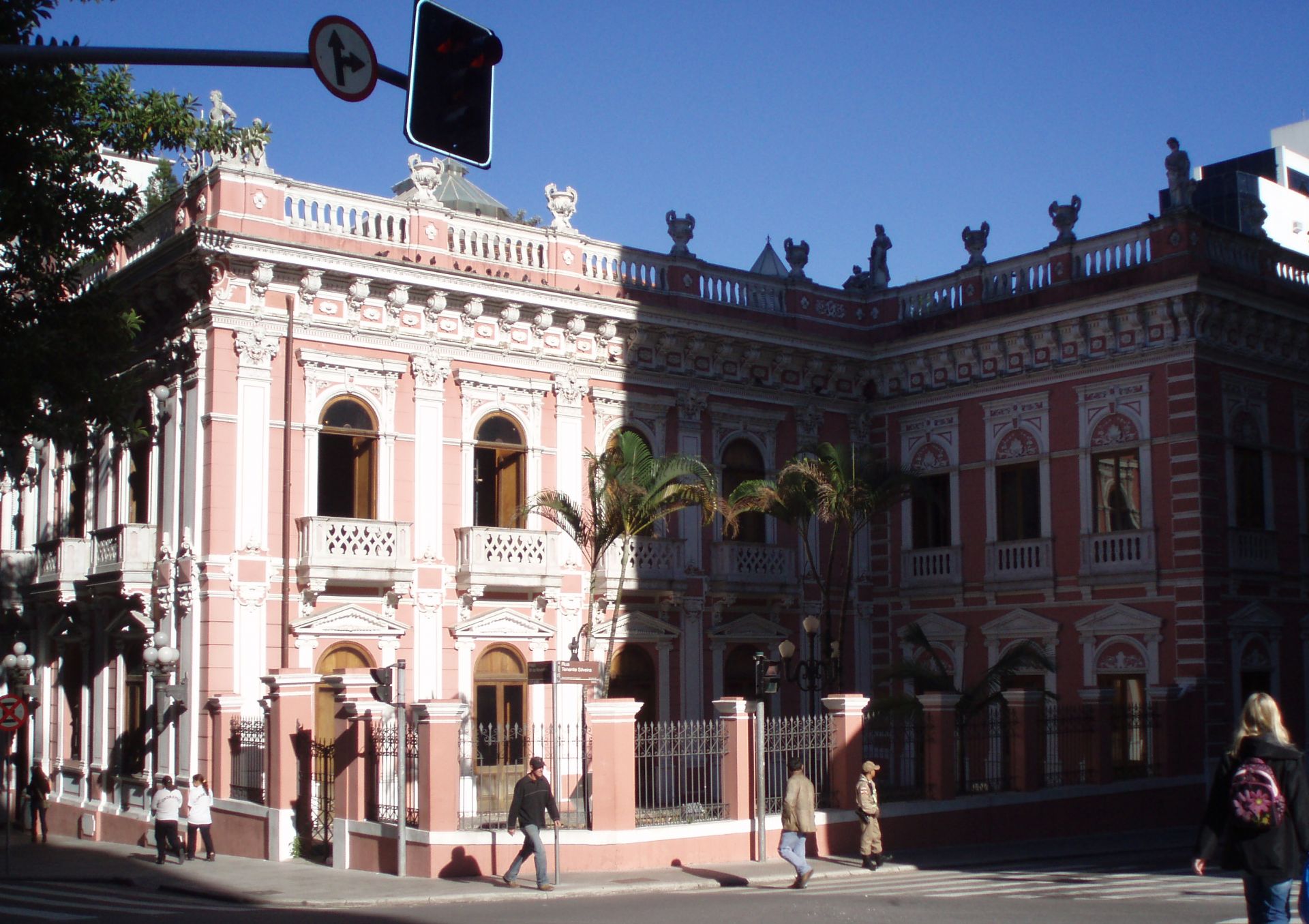
The Historical Museum of Santa Catarina is located in the chic Palacio Cruz e Sousa historic building in the heart of Florianópolis. Everyone should visit it to learn more about the peculiarities of life and culture of one of the 27 states of Brazil.
The Palacio Cruz e Sousa was built in the mid-18th century: a three-section building with two floors was intended for government services. In 1894-1898, a significant restructuring of the palace was carried out. So it acquired the architectural features that have survived to this day.
The exterior of the building is decorated with ten statues created by the Italian artist Gabriel Silva. Among them is the patron Saint of Santa Catarina; the memorable sea nymph Amphitrite; the mythological god Mercury with two barrels, symbolizing state trade and industry. The paving slabs in front of the palace was laid in 1910.
In 1977, large-scale restoration work was carried out there. In 1984, the building was included in the List of World Heritage Sites in Brazil. Then the original architectural features of the structure were restored. Since 1986, it has been home to the Historical Museum of Santa Catarina. In 2005, decorative paintings on the interior walls and plastered ceilings were restored.
Now the magnificent staircase with its balustrade and Italian-made balconies made of Carrara marble is particularly impressive inside the Palacio Cruz e Sousa. Art Nouveau stained-glass windows and bronze statues of medieval knights also stand out among the interior decor.
The museum collection consists of items of the 19th and 20th centuries: furniture, paintings, printed documents, medals, photographs, weapons. There is also an urn with the ashes of the poet João da Cruz e Sousa. The historical building was named after him.
Visitors to the Historical Museum of Santa Catarina can take a virtual tour with an audio guide. You can use it to get information about the main works in text and audio formats in five languages: Portuguese, English, Spanish, French, and Italian. You can download the audio guide on the official website of the museum.
